
By Lexi Marshall
HIGH ABOVE the treeline, where the air thins and peaks pierce the sky, Colorado’s alpine landscape tells a fragile story. Each footstep on this delicate ecosystem can damage plants that took decades to establish, in an environment where recovery happens significantly slower than in the forests below. Yet, as Colorado’s tourism industry continues its remarkable growth, with visitors spending $28.5 billion in 2024, a powerful movement is reshaping how the state welcomes travelers while protecting its most precious natural assets.
Colorado is pioneering a new approach to tourism—one that doesn’t simply minimize harm but actively works to preserve and restore the landscapes that make the state a world-class destination. From its iconic fourteeners to century-old hotels, sustainability has become more than a buzzword; it’s a guiding principle transforming every aspect of the visitor experience.
A STATEWIDE COMMITMENT TO STEWARDSHIP
The Colorado Tourism Office has emerged as a national leader in sustainable destination management, becoming the first U.S. state tourism office to establish a dedicated Destination Stewardship department. In 2024, the office unveiled a landmark 10-year Destination Stewardship Strategic Plan, developed with input from more than 1,000 stakeholders across the state. This comprehensive roadmap addresses everything from visitor education to climate action, setting a bold vision for tourism as a force for good.
“Colorado is setting the standard for responsible and sustainable travel,” says Timothy Wolfe, director of the Colorado Tourism Office. “State, regional and local partners across the state are dedicated to providing unforgettable experiences for visitors, while boosting quality of life for residents and safeguarding our natural environment and cultural heritage.”
Central to Colorado’s sustainable tourism efforts is the “Do Colorado Right” campaign, a multi-faceted education initiative that encourages responsible visitor behavior. Twenty-three communities across the state, including Frisco, Breckenridge, Glenwood Springs and Steamboat, have adopted customized versions of this messaging to fit their local needs. The campaign addresses practical concerns—from proper waste disposal to wildlife interaction—in ways that resonate with visitors eager to protect the places they’ve come to enjoy.
Complementing these efforts is the “Do Colorado Right” initiative, a lighthearted but crucial program addressing human waste on public lands. Originating with the Gunnison Crested Butte Tourism and Prosperity Partnership and supported by more than 30 partners, the program has distributed over 10,000 pack-out bathroom kits at trailheads. Recent surveys demonstrate measurable shifts in visitor behavior, proving that education can be both effective and scalable.
Transportation is another critical component of Colorado’s sustainability landscape. Drive Clean Colorado—a nonprofit designated as a U.S. Department of Energy Clean Cities and Communities coalition—supports communities, fleets and travelers in adopting cleaner transportation options. Through education, technical assistance, grant support and electric-vehicle outreach, the organization works to reduce emissions and advance cleaner mobility across the state, a key factor in lowering the environmental footprint of tourism.

PARTNERING WITH LEAVE NO TRACE
In 2018, Colorado became the first state to officially partner with the Leave No Trace Center for Outdoor Ethics, creating the Care for Colorado Leave No Trace Principles. In 2020, the Colorado Tourism Office and Leave No Trace founded a coalition that now includes hundreds of partners committed to protecting Colorado’s environmental and cultural resources. This alliance of state and federal agencies, local governments, nonprofits and tourism businesses has become a model for collaborative conservation.
The Care for Colorado Coalition promotes seven principles designed to inspire low-impact travel: respecting public lands, exploring less-visited destinations, practicing proper waste disposal, being careful with fire, observing wildlife from a distance, being considerate of others and planning ahead. These principles are reinforced through educational materials at all 10 Colorado Welcome Centers, animated videos and extensive social media campaigns that reach millions of visitors annually.
“That commitment to sustainability is getting noticed by visitors who value sustainability, making them more likely to visit our state,” Wolfe says.
PROTECTING COLORADO’S FOURTEENERS
Colorado’s 58 peaks above 14,000 feet represent some of the most beloved—and heavily impacted—destinations in the state. The Colorado Fourteeners Initiative (CFI), formed in 1994, has spent more than three decades addressing the environmental challenges created by increasing visitation through active stewardship and public education.
“CFI has long understood that, for better or worse, Colorado’s fourteeners will always call to those who love climbing mountains. We can’t—and don’t want to—control that,” says Lindsey King, CFI deputy director. “What we can control is ensuring that these peaks have sustainably built trails that minimize hiker impacts to the surrounding alpine environments so that people generations from now can enjoy these special places.”
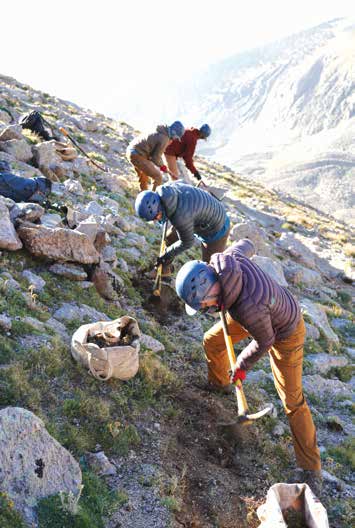
The organization’s Sustainable Trails Program has documented an estimated 1.3 billion pounds of soil lost to erosion from alpine trails—a staggering figure considering it takes approximately 1,000 years for one inch of soil to accumulate in these extreme environments. In response, CFI has constructed 41 sustainably located, durably built summit trails on 36 fourteener peaks, each designed to withstand heavy use while minimizing ecological damage.
In 2025, the state awarded CFI a $250,000 grant to reconstruct and restore 12 summit trails on fourteeners, including basic maintenance, intensive trail reconstruction and thousands of feet of closure and restoration work. The organization’s Nomad program has engaged volunteers for more than 22,942 days of trail stewardship since 2001, with recent years averaging roughly 1,200 volunteer days per season.
Beyond trail work, CFI educates hikers about Leave No Trace principles and sustainable recreation practices. The organization tracks hiker use to correlate on-the-ground impacts with hiking activity, providing crucial data that informs management decisions. Their most recent hiking use report estimated that 265,000 hiker use days occurred on fourteeners in 2024, down from a pandemic peak of 415,000 in 2020, suggesting hiking use not only fluctuates based on broad societal changes but also on things like land management practices and parking restrictions at trailheads.
HOTELS LEADING BY EXAMPLE
While outdoor recreation captures headlines, Colorado’s hospitality sector is quietly revolutionizing sustainable practices from within. The historic Hotel Boulderado in Boulder exemplifies how heritage properties can embrace environmental responsibility without sacrificing guest comfort or character.
“The Boulderado has been dedicated to sustainability practices for decades,” explains Laurel McKown, the hotel’s on-site historian and head of housekeeping. “The fact that this soon-to-be 117-year-old hotel has not landfilled the bricks, stonework and even furnishings by being razed for a new building is a huge factor for its sustainability status. Just think of that carbon footprint to rebuild.”
The hotel’s comprehensive sustainability program includes recycling hangers, batteries, scrap metal, glass, aluminum cans, plastic bottles, cardboard, newspapers, office paper, eyeglasses and electronics. Larger items like furniture and office equipment are donated to appropriate organizations, while linens, toiletries and clothing that can no longer be used on-site are redirected to local organizations that distribute them to people who need them.
Water and energy conservation efforts extend to guest participation. “We are able to conserve both water and gas by offering not to change linens on a daily basis for most guests,” McKown notes. “Of course, we change out linens as requested by guests, but most guests want to conserve.” The hotel also participates in the Eco Pass program, providing free bus passes that encourage employees to use public transportation rather than drive to work.
Across the state, individual properties continue to pursue renewable energy and green-building strategies. Devil’s Thumb Ranch in Tabernash documents its use of solar and geothermal systems, while The Westin Riverfront in Avon maintains a LEED Silver certification through the U.S. Green Building Council.
MOUNTAIN RESORT COMMUNITIES SET THE STANDARD
In Colorado’s high-country destinations, sustainability has shifted from aspiration to action. Vail became the first destination certified to the Mountain IDEAL standard—an independently verified framework recognized by the Global Sustainable Tourism Council and tailored to the environmental and cultural realities of mountain communities. The certification reflects years of work on land management, resource efficiency and workforce housing. As part of this process, Vail reports that a significant portion of its defined destination area is protected from development.
Other communities have taken similar steps. Breckenridge earned Mountain IDEAL certification in 2021, and Aspen joined the list in 2024 after completing a multi-year assessment that evaluated everything from resource planning to cultural and community considerations.
Ski-area operators have also contributed to Colorado’s broader sustainability progress. Aspen Skiing Company reports a methane-to-electricity project launched in 2012 that captures waste methane from a former coal operation and converts it into power for the regional grid. Vail Resorts has outlined long-term goals through its “Commitment to Zero” program, which includes targets for waste reduction, emissions and habitat restoration, and publishes progress in annual reports. The company says that it is “well on its way” to achieving a zero net operating footprint by 2030.
Colorado’s leadership now extends beyond environmental stewardship to accessibility. In October 2025, the Colorado Tourism Office selected four new participants for its Accessible Travel Program—Snowmass Tourism (in partnership with Aspen Chamber Resort Association), the Town of Mountain Village, Visit Durango and Visit Estes Park. In collaboration with Wheel the World, the program provides accessibility assessments, staff training and tools to help destinations identify and promote verified accessible experiences across lodging, attractions, trails and transportation.
THE PATH FORWARD
Colorado’s mountain communities have shown what intentional stewardship can look like, but the broader question now is how to scale these efforts across a rapidly growing tourism landscape. The state’s tourism economy continues to expand—supporting 188,000 jobs and contributing billions to local communities—but that growth comes with mounting pressure on the very ecosystems that draw visitors in the first place. White River National Forest, home to Maroon Bells and already the busiest national forest in the country, saw visitation climb 53 percent from 2017 to 2022. Forest supervisor Scott Fitzwilliams has been clear about the challenge: while current tourism brings in $1.6 billion in economic impact, its long-term sustainability for the forest’s ecological values is far from guaranteed.
In response, Colorado has begun building a more comprehensive model for managing visitation—one that blends public education, infrastructure improvements, destination certifications and cross-agency partnerships. Together, these efforts signal a shift toward treating tourism as a shared responsibility and a mechanism for conservation, rather than solely an economic driver.
As travelers continue to seek out Colorado’s expansive landscapes and outdoor experiences, they’re increasingly encountering destinations taking active steps to balance access with protection. The work ahead is complex, but the trajectory is clear: Colorado aims to ensure that its alpine environments, public lands and mountain towns remain not just remarkable places to visit, but resilient places to steward for generations.