Artists Christy Lynne Seving and Josh Davy explore structures and impermanence through painting and sculpture
By: Kastle Waserman
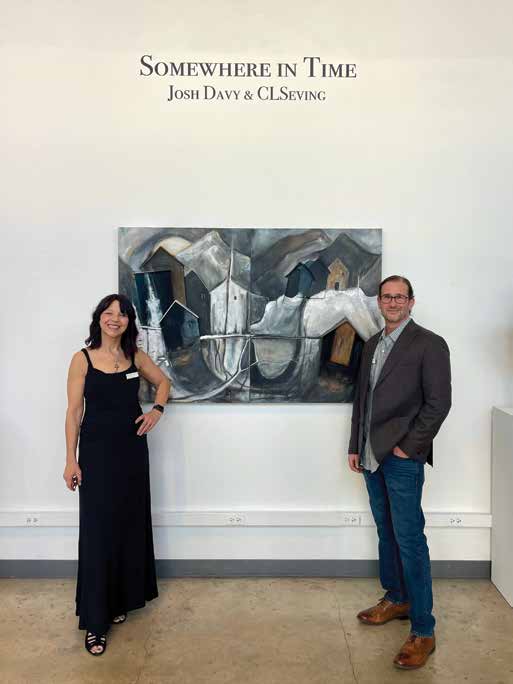
HOME MEANS DIFFERENT THINGS to different people. From safety to displacement, the human experience as it relates to homes and structures is what artists Christy Lynne Seving and Josh Davy often explore in their work. The pair, who are partners in life and art, recently collaborated on “Somewhere in Time,” a collection of paintings and sculptures that explore the tension between human efforts to build structures, the reality of impermanence, and how we find meaning in the moments between.
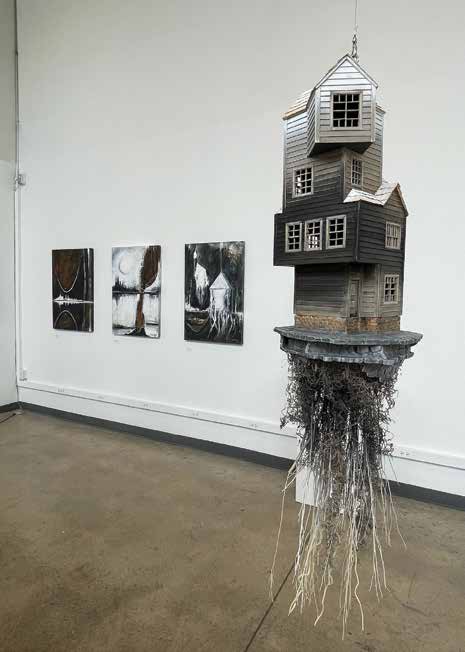
Davy grew up in the Midwest and came to Denver in 2010 after attending art school, then leaving to work in construction. The skills he learned there came full circle back to his art, creating structures that open dialogues about the idea of home. His work showcases hanging model houses, juxtaposed with one side up and the other side down, some as if pulled from the ground with roots dangling, others shadowed in creeping darkness.
Davy says the home sculptures were inspired by gentrification, as encroaching development pushed out the gallery he belonged to. “I was looking at gentrification not necessarily as a horrible thing, but as something to be thought about and how it changes our lives dramatically,” he says. The work also reflects on people’s relationships with buildings—particularly homes. It came after Davy embarked on a cross-country road trip and photographed abandoned buildings along the way. “I started thinking of home as a moment in time, all the things it is for us, and what I wanted to say about my own life,” he says.
Seving is a Denver native and mixed-media artist currently focused on oil and acrylic painting, cold wax, and ink. Her collaboration with Davy came naturally; she says houses, structures, cities, and maps have always drawn her in. Her paintings depict city and suburban landscapes, distorted, dark, and smudged, as if drawn from memory, and a large-scale piece done with Davy, where house-like structures protrude three-dimensionally from the painting itself.
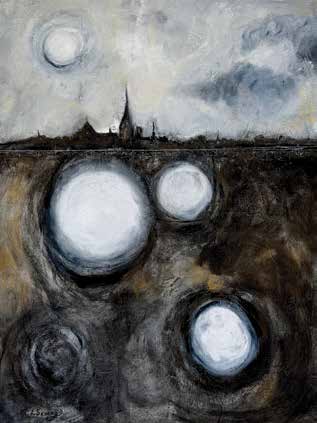
“I based the paintings on how I felt at the time—houses swept up like they’re being lifted and drifting away,” Seving says. “The paintings kept changing over time, and I recognized I was sweeping through my emotions. That’s kind of how a lot of my work goes, just capturing a feeling, and those feelings can change. It almost mirrors spiritual growth, or where I am in the moment.”
Seving says the notion of home is what connects with everybody across class and culture. “It represents safety and refuge,” she says. “If it’s not there, if someone is unhoused, there is a sense you no longer fit; you’re displaced from society.”
Both Seving and Davy found that people drawn to their work often see something of their own lives in them. “With one of Josh’s pieces, we had people come up and say, ‘I know that place,’” says Seving. “Somehow, they can see it even though it was based on a photo and a feeling. With my collectors, the open, abstract nature of my work allows them to find their own meaning. They can connect to it because it captures an emotion that is universal.”
Davy sums it up best: “For art to be meaningful, I have to have a relationship with it, then I hand it off to someone who then has their own relationship with it.” Learn more on their websites: christylynneseving.com and joshdavy.com.