
Research suggests that giving to others can boost happiness
By Kastle Waserman
FOR SOME, CHARITABLE GIVING is a way of life. Parents teach children to routinely give a portion of their income to charity or volunteer their time. Others come to it out of a desire to help people and make their community—and the world—a better place. Some never give because they lack funds or worry that donating may feel burdensome. Dr. Mark Aoyagi, PhD, a professor in the Graduate School of Professional Psychology at the University of Denver, disputes that concern. He cites the 2008 study, “Spending Money on Others Promotes Happiness,” published in the journal Science, which found that when people were given a small amount of money—$5 or $20—to spend on either themselves or somebody else, those who spent it on other people reported being significantly happier than those who spent it on themselves.

Dr. Aoyagi notes that the amount of money didn’t matter. It was simply the act of giving. He says giving is rooted in evolutionary, pro-social behavior tied to tribal survival instincts. “Research suggests that we’re social creatures. We get rewards, sometimes tangible, sometimes intangible, like happiness, when we do things that support other people and support the tribe, so to speak, going back to our ancient roots. So, whether it’s material goods, time, or support, we inevitably feel better when we do that.”
And while we may know this from experience or because science tells us, in case we forget, there are gentle reminders for giving. This is where regular events such as Colorado Gives Day come in. Aoyagi says this annual day of giving serves a psychological function by providing a structured moment to act on existing desires to give. And giving can also be contagious. Social norms and peer behavior strongly motivate charitable action.

For those who need to know the impact of their giving, Marcus Turner, Associate Executive Director for External Relations at Lone Tree Arts Center, can give a strong example. Lone Tree Arts Center (LTAC) participated in Colorado Gives Day for the first time in 2025 through its nonprofit arm, the Lone Tree Arts Center Fund, which became eligible after five years of self-sustaining existence. Donor contributions went directly to programming—not to facility, overhead, or personnel costs—due to LTAC’s unique city-owned structure. Colorado Gives Day participation boosted LTAC’s nonprofit fundraising budget by approximately 20 to 25 percent.
“Basically, half of the programming costs are covered by tickets, and the rest has to be covered by contributions,” says Turner. “It’s not enough to just sell tickets. We’re always striving to reach more people, and do more elevated programming, and really have a deep impact in our community. We couldn’t do it without contributions.”
Turner says contributions allow the art center to bring more exceptional artists and experiences to the community and offer impact programming, such as:
• SPARK!—a free program funded in part by donations for people experiencing mild memory loss, early-stage Alzheimer’s, or a related dementia.
• Performative Movement—a free workshop primarily for people with Parkinson’s that uses simple guided activities inspired by theater and expressive arts to help explore how the body moves and expresses.
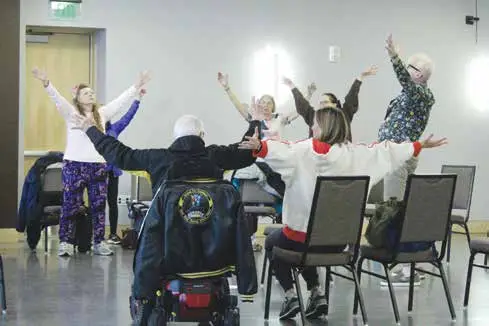
Turner says fundraising is like a funnel, starting with a person’s first visit for an event. “That’s their introduction and how they get to know us. That informs whether they’re going to come back again and maybe be a subscriber. Then they’re willing to donate through Colorado Gives Day at the end of the year. Then maybe they’re willing to increase their donation next year. So, it really is playing the long game, and it starts with the programming and experience we offer.”
When it comes to giving, Dr. Aoyagi says that modern society’s over-emphasis on the self, amplified by social media, is linked to increased anxiety and depression. Giving helps shift focus outward. However, few people realize the benefits.
“Studies show we are poor ‘affective forecasters,’ to use a psychological term, which is forecasting how we think we’ll feel as a result of doing something,” he says. “We think that donating may somehow be unpleasant. But over and over, we find that when people donate, they have feelings of happiness and well-being.”
Whether you regularly donate or volunteer for your favorite organizations or simply want to experience the benefits of giving, Colorado Gives Day, happening this year on December 8, is the perfect opportunity. Find participating Colorado nonprofits at coloradogives.org.