
ALLISON KENT-SMITH KNOWS what strong consumer demand feels like. She has founded three startups, spent more than two decades in technology and marketing, led digital transformation for companies and agencies, and focused her career on understanding consumer behavior.
Still, she wasn’t quite prepared for what happened when she put a rack of designer resale clothing in a hotel lobby.
Lotwear’s first installation sold nearly 70 percent of its inventory in four days.
“We were like, are people going to get this?” Kent-Smith says. The concept was self-service, unfamiliar, and decidedly unlike conventional hotel retail: See something you want, scan the tag, buy it, and take it with you. “People were tracking me down for my phone number and asking when we were going to be in their city. From a three-time startup founder, the market pull was something I’d never seen before.”
Now, with Lotwear installed at Moxy Denver Cherry Creek, Kent-Smith is bringing that model to one of Denver’s most style-conscious neighborhoods—and demonstrating why the deceptively simple rack is really a much bigger business idea.
She calls it ambient retail.
“The racks really aren’t about being a pop-up,” Kent-Smith says. “It’s about an install—what I call ambient retail—where retail is in the background of where you are in third spaces.”
That distinction is central to the model.
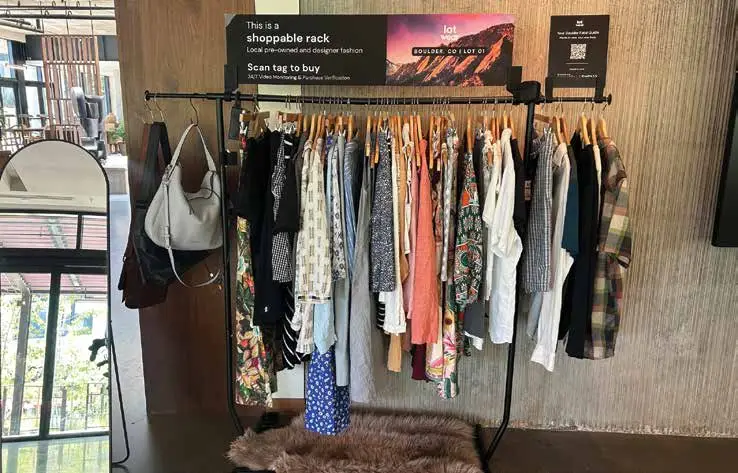
Lotwear isn’t asking hotels to open stores, buy merchandise, staff retail counters, or take on another operational headache. Instead, it places a curated assortment of luxury resale fashion into spaces where people already linger, socialize, work, and move through their day.
Kent-Smith looks for properties with dwell time and energy—lobbies where people grab a drink, meet friends, work for an hour, or simply hang out. Placement matters, too. The rack needs to feel discovered without being hidden.
It’s retail without much of the machinery consumers associate with retail—and without much of the burden for the host property.
“Creating a footprint for retail at no cost and providing a guest amenity at no cost to the hotel is a really compelling partnership,” Kent-Smith says.
Her route to retail disruption began, somewhat unexpectedly, with her then-14-year-old daughter, who was shopping almost exclusively secondhand. Kent-Smith started tagging along, observing shoppers and researching a resale market she says is growing four to five times faster than traditional retail. Then she connected those observations with her previous work in the travel industry and a career spent studying consumer behavior.
The opportunity wasn’t simply resale. It was putting desirable product into environments where people had the time—and mindset—to discover it.
But Lotwear’s racks aren’t stocked with interchangeable designer goods shipped from a central warehouse. The luxury fashion is deliberately connected to where each rack lives.
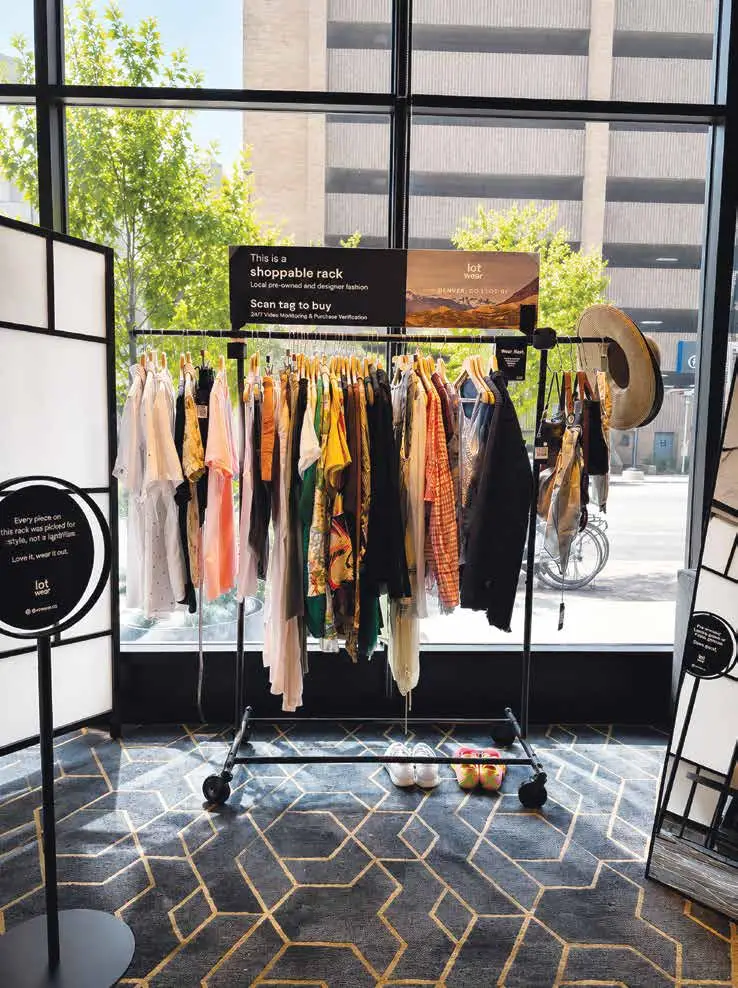
Cherry Creek should look like Cherry Creek. Boulder should look like Boulder. New York should look like New York. Many of the designer labels may overlap, but the mix shifts with the market—the outdoor and performance brands that make perfect sense in Boulder, for example, give way to a more fashion-driven edit in Cherry Creek.
“The most important thing to think about is: Are we styling for the place that the rack sits?” Kent-Smith says. “The clothes tell stories about the place.”
That sense of place is also baked into Lotwear’s strategy for scale.
Kent-Smith’s vision calls for local curators who know their markets intimately—not simply what labels carry cachet, but what people actually wear, where the best pieces are hiding, and what belongs in a particular hotel or neighborhood.
Collections can also incorporate local designers and guest brands, further rooting each rack in its community.
“It really has to feel like the place, and you can only do that really effectively if you live there and you understand the people in the place,” she says. “Local curators will have racks that they’re curating based on the place, and that’s how it scales.”
The longer-term model could take the form of licensing or franchising. Lotwear would secure locations and provide the brand, commerce infrastructure, standards, and back-end systems; local operators would source, stock, and manage the collections. Instead of attempting to centralize taste, Kent-Smith is building a structure designed to distribute it.
Hotels are the starting point, not the boundary.
Lotwear is already moving into coworking spaces, and Kent-Smith sees potential anywhere interesting people spend meaningful time. Sustainability adds another dimension: Resale extends the life of existing clothing, while future brand partnerships could create another channel for garments before they enter the waste stream.
For Kent-Smith, though, the strength of the concept comes back to timing, behavior, and an idea that feels intuitive once you see it in action.
“As a startup founder, timing is everything,” she says. “And it’s the right time.”
At Moxy Denver Cherry Creek, that future of retail doesn’t announce itself with a storefront or sales associate. It’s simply there, woven into the environment, waiting to be discovered.
Which, of course, is exactly the point.
LOTWEAR
lotwear.com