
On fall Saturdays across Colorado, stadiums fill long before kickoff
By Lexi Marshall
ON FALL SATURDAYS across Colorado, stadiums fill long before kickoff. Fans stream through campus quads wrapped in school colors, marching bands echo across the foothills and mountain valleys, and the aromas from tailgate grills drift through crisp alpine air.
While Colorado is known for its outdoor recreation, it is also home to a thriving collegiate sports scene. National championship programs, historic rivalries, and sold-out venues have helped put Colorado colleges on the national stage.
UNIVERSITY OF COLORADO: A NATIONAL SPOTLIGHT
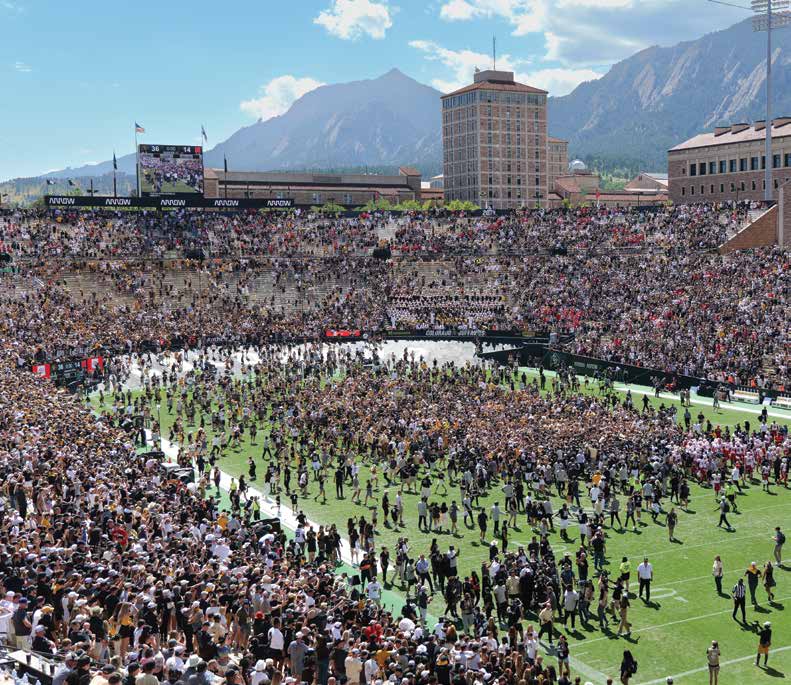
Few programs have garnered as much attention in recent years as the University of Colorado Boulder (CU). The Buffs have reemerged as one of the most visible programs in college sports, thanks largely to the dramatic turnaround under head coach Deion Sanders.
Colorado went from a 1-11 season in 2022 to a 9-4 campaign and Alamo Bowl berth in 2024, led by Heisman Trophy winner Travis Hunter and quarterback Shedeur Sanders. The surge made CU a national television draw, with several games ranking among the most-watched in college football, while season tickets at Folsom Field sold out for three consecutive years.
The success proved harder to sustain in 2025, but the program’s renewed visibility has brought increased attention and game-day visitors to Boulder. Set against the Flatirons, Folsom Field remains one of the country’s most scenic college football venues and a centerpiece of Colorado’s sports culture.
COLORADO STATE UNIVERSITY: MOMENTUM IN FORT COLLINS
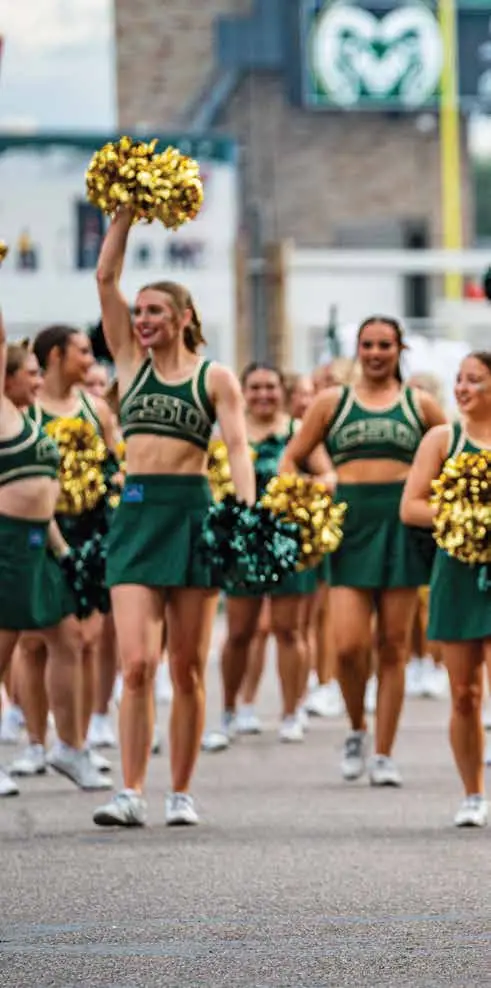
To the north, Colorado State University (CSU) continues building a strong athletic identity of its own.
“Athletics is the front porch to any university,” says Ryan Pfeifer, senior director of strategic communications and brand enhancement for Colorado State Athletics. “Colorado State is a great tier-one research institution, and we want to use our athletic success to help tell that story.”
Rams football remains the main event of CSU athletics, but women’s volleyball has become one of its most recognizable athletic organizations, regularly selling out Moby Arena and ranking among the nation’s attendance leaders.
On July 1, CSU officially joined the Pac-12, aligning with schools including Boise State, Fresno State, Gonzaga, Oregon State, San Diego State, Utah State, and Washington State.
For visitors, the appeal extends beyond the games themselves. “Colorado State and Fort Collins have a unique relationship with campus just 10 minutes from Old Town,” Pfeifer says. “The game-day fan experience doesn’t just start on Saturday, but on Friday with the Old Town Pep Rally.”
First-time visitors should watch for CSU’s longstanding traditions: the giant white “A” painted on the foothills west of campus, the booming Comatose cannon that fires after every Rams score, and CAM the Ram, the university’s live mascot, roaming the sidelines. Confused about the “A”? It stands for Aggies, which was the original nickname for CSU’s sports teams.
UNIVERSITY OF DENVER: CHAMPIONSHIP CULTURE
While larger schools often dominate headlines, the University of Denver (DU) has built one of the most impressive championship traditions in college sports.
“It comes down to a committed university that attracts great people and fosters healthy cultures,” says Niko Blankenship, director of athletic communications at DU. “Our exceptional coaches recruit great student-athletes with championship expectations.”
That formula shows clearest in hockey. Denver now owns 11 NCAA men’s hockey championships, the most in college hockey history, after beating Wisconsin in the 2026 national title game, the school’s third title in five seasons (2022, 2024, 2026). Magness Arena anchors the fan experience, but DU has also drawn massive crowds on bigger stages: more than 35,000 fans for an outdoor game at Coors Field in 2016, and nearly 18,000 at Ball Arena in 2023, the largest indoor crowd in program history.
Denver’s ski team has won 24 NCAA team titles, the most of any school in the country. Men’s lacrosse made history in 2015 as the firstNCAA champion from outside the Eastern time zone. Gymnastics has produced NCAA individual champions and regional titles, and men’s soccer reached the national semifinals in 2024.
“Not having a football program to prioritize has allowed us to continue to pursue comprehensive excellence across many of our programs,” Blankenship says.
For sports fans, DU offers access to nationally elite competition in an intimate setting just minutes from downtown Denver.
AIR FORCE ACADEMY: SUCCESS THROUGH SERVICE
At the U.S. Air Force Academy, athletic achievement is measured alongside leadership and service.
Unlike most Division I schools, Air Force recruits student-athletes who understand that graduation comes with a commitment to serve. Cadets must complete a minimum of five years of active-duty military service after earning their degree.
“Air Force cadet-athletes are different than other Division I student-athletes because of their commitment to service,” says Troy Garnhart, associate athletic director for communications. “Air Force, along with Army and Navy, recruit athletes that are not motivated by financial gain, but rather want to compete at the highest level while preparing to serve their country.”
The Falcons have paired that mission with sustained excellence. Air Force has won the Commander-in-Chief’s Trophy more than 20 times, more than either Army or Navy, and has been one of the Mountain West’s steadiest football programs since the conference’s founding in 1999. The program’s modern peak came in 2019, when the Falcons went 11-2 and won the Cheez-It Bowl under longtime head coach Troy Calhoun.
“We have a world-class education,” Garnhart says, noting that cadet-athletes attend school in Colorado and graduate with a guaranteed job and valuable leadership experience.
Home games at Falcon Stadium in Colorado Springs offer a game-day setting that’s hard to top, with the Rocky Mountains framing a campus unlike any other in college athletics.
COLORADO COLLEGE: A HOCKEY TRADITION UNLIKE ANY OTHER
Colorado College holds a unique spot in the state’s athletic landscape. While most Tigers teams compete at the NCAA Division III level, the school fields Division I teams in men’s ice hockey and women’s soccer.
Hockey is the heart of it all. The Tigers won NCAA national championships in 1950 and 1957 and have made multiple Frozen Four appearances, including a runner-up finish in 1996. Today, they compete in the National Collegiate Hockey Conference alongside several of the nation’s top institutions.
A major milestone came in 2021 with the opening of Ed Robson Arena, a $52 million, 3,400-seat venue that gave Colorado College hockey its first on-campus home in program history. Built as part of Colorado Springs’ City for Champions initiative, the arena has transformed the fan experience and become a true nucleus of Colorado College athletics.
THE RISE OF WOMEN’S SPORTS
Colorado’s athletic achievement story extends beyond the traditional powerhouse programs. Women’s sports continue to see unprecedented growth, both statewide and nationally. Few people have watched that transformation up close more than Ceal Barry, former University of Colorado women’s basketball coach and deputy athletic director.
According to Barry, one of the biggest changes has been the expansion of opportunities available to female athletes. Over the course of her career, colleges added sports such as soccer, lacrosse, gymnastics, golf, and softball, while newer offerings increased access even further.
“Programs as varied as bowling, acrobatics, equestrian, and ice hockey provide opportunities nationally for high school girls to compete in college,” she says.
Professional opportunities have evolved just as dramatically. When Barry began coaching in the 1980s, female athletes hoping to earn a living through sports were largely limited to golf and tennis or competing overseas. Today, leagues such as the WNBA, professional soccer, volleyball, softball, and lacrosse offer viable pathways after college.
Barry also credits organizations such as Sportswomen of Colorado with helping elevate female athletics across the state by recognizing and celebrating generations of female athletes.
“I would point to the ‘96 Olympics in Atlanta, which showcased outstanding women athletes, as a turning point for increased media coverage,” Barry says.
Looking ahead, Barry sees more barriers crumbling across the sports landscape, with more women coaching men’s teams, leading athletic departments, officiating major competitions, and serving as prominent voices in sports broadcasting.