
The objects that made a state
By: Lexi Marshall
AS COLORADO MARKS ITS 150th anniversary of statehood in 2026, we explored artifacts that tell the full story—from a stone point chipped by human hands 13,000 years ago to a civil union license signed in 2013. These are the objects that capture who we were, what we built, and how we got here.
WILBUR FISK STONE’S GOLD INGOT
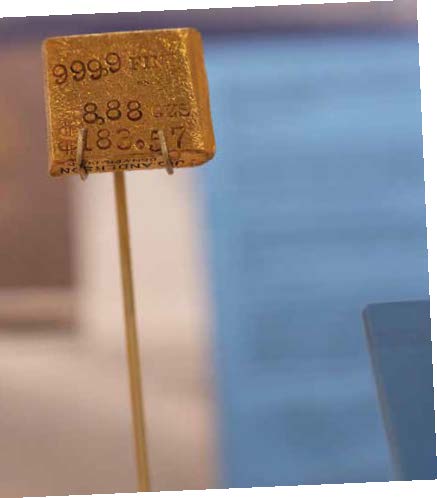
This 5.5-ounce gold bar—worth about $168 at the time—carries the story of Colorado’s first great rush in a single object. Wilbur Fisk Stone arrived in the Rockies in 1860 and, by 1864, was working a placer claim in South Park. The following year, he had accumulated enough gold to have it smelted into this ingot at the U.S. Branch Mint at Denver.
His experience was typical of the era. In the early camps, gold dust was currency—worth about 25 cents a pinch, but too imprecise for commerce. Private mints like Clark, Gruber & Co. moved quickly to transform dust into coins and bars until the U.S. Branch Mint took over. This is the only gold ingot known to survive from that mint’s operation in Denver, making this modest bar a rare artifact of Colorado’s early territorial economy.
A STONE POINT THAT REWROTE COLORADO’S HUMAN HISTORY
Small enough to fit in the palm of your hand, this Paleo-Indian spear point carries an outsized story. Chipped from stone between 11,700 and 12,900 years ago, it was unearthed at the Lindenmeier site near Fort Collins. Its discovery changed everything scholars thought they knew about human habitation in North America.
When archaeologists excavating Lindenmeier in 1935 found a point like this lodged in the spine of an extinct bison, it overturned the prevailing belief that humans had lived on the continent for only 3,000 to 4,000 years. These projectiles take their name from Folsom, New Mexico, where the style was first identified, but Colorado’s Lindenmeier site—now on the National Register of Historic Places—provided undeniable proof that people called Colorado home as far back as 13,000 years ago.
THE CHAIR THAT LAUNCHED COLORADO’S SKI INDUSTRY
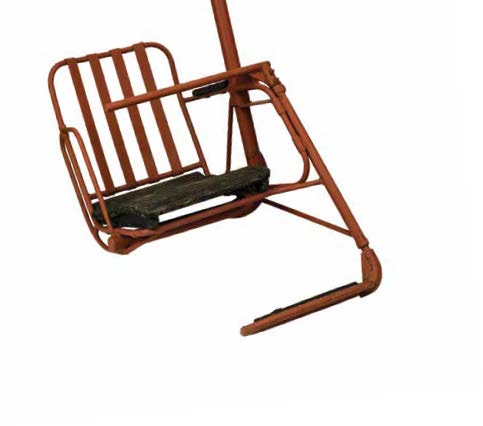
This single-seat chairlift chair from Aspen Mountain’s Lift No. 1 dates to 1946, the founding year of the Aspen Skiing Company. At just $3.75 for a daily ticket, skiers could ride what was then the longest chairlift in the world to the top of the mountain—and in the powder-covered decades that followed World War II, Coloradans and tourists alike flocked to it. The connection to the 10th Mountain Division ran deep from the very start. Many of Aspen Mountain’s first employees were veterans of the famed Colorado-trained mountain warfare unit. Friedl Pfeifer, a 10th Mountain veteran, headed the ski school, while Pete Seibert—another veteran who served on the Aspen Ski Patrol—later went on to found Vail Mountain in 1962.
ART MADE BEHIND THE FENCES OF AMACHE
This heart-shaped handcrafted pin was made by prisoners at Amache, a Japanese American internment camp near Granada in southeastern Colorado. Between 1942 and 1945, Amache held more than 7,000 Japanese Americans, many of them U.S. citizens, forcibly imprisoned in the aftermath of Pearl Harbor. For some of the 120,000 people incarcerated across the country’s camps, making art offered a measure of comfort in deeply unjust circumstances.
In Japanese, gaman means to bear the unbearable with dignity and patience. These delicately crafted pins embody that spirit—and were collected by Jeanne Hanamura Higashi, who was just 6 years old when she was imprisoned at Amache with her family.
THE SIGNATURE THAT MADE COLORADO A STATE
This single handwritten page, dated Washington, August 1, 1876, is one of the most consequential documents in Colorado history. Signed by President Ulysses S. Grant, it directed the Secretary of State to affix the Seal of the United States to his proclamation—the formal act that admitted Colorado as the 38th state in the Union.
The timing was fitting. Colorado joined the nation just days before its centennial, earning it the enduring nickname the Centennial State. In elegant script, Grant’s signature and a brief authorization were all it took to transform a territory into a state.
THE LEVER THAT LAUNCHED DENVER’S FIRST NEWSPAPER
On April 23, 1859, William Byers pulled this lever to print the first edition of the Rocky Mountain News. The R. Hoe & Company press it belonged to became a key instrument of Colorado’s early identity—Byers deliberately set up his office in the dry streambed between rival settlements Denver City and Auraria to avoid any appearance of favoritism.
The paper quickly drew national attention, with Byers using its pages to lure gold seekers and settlers westward. In 1864, a catastrophic Cherry Creek flood swept away both the press and the building. Thirty-four years later, this lever resurfaced during viaduct construction near the confluence of Cherry Creek and the South Platte River. It is all that remains of the press that helped build a city the paper would serve for nearly 150 years, until its final edition in 2009.
A DOCUMENT OF HARD-WON RIGHTS: COLORADO’S CIVIL UNION LICENSE
This civil union license, issued December 7, 2013, in Lone Tree, belongs to Garth Criswell and Mark Kraft—one of the first couples to unite under Colorado’s newly passed Civil Unions Act, which the Colorado General Assembly legalized earlier that year, extending critical legal protections to same-sex couples for the first time.
The road to that moment was long and contested. Boulder County had briefly issued same-sex marriage licenses as far back as 1975. In 1992, Colorado voters passed Amendment 2, which stripped away any governmental protections for LGBTQ+ individuals in the state, until the U.S. Supreme Court struck it down in 1996. Civil unions represented the latest milestone in that ongoing struggle, and two years later, the U.S. Supreme Court affirmed marriage equality nationwide in 2015.
A SACRED OBJECT OF THE ARAPAHO CLUBBARD LODGE SOCIETY
This striking ceremonial object—crafted from wood, paint, buckskin, eagle feathers, and eagle claw—belongs to the Clubbard Lodge, one of the Arapaho Men’s Societies organized by age. The Arapaho people have always maintained a deep connection to the land, and this piece reflects that relationship in both its materials and its purpose.
When the Arapaho lived near the Great Lakes region, they were an agricultural people who grew vegetables and relied on ceremonies like those of the Clubbard Lodge to ensure a healthy growing season. As the Arapaho moved westward onto the Plains, the Clubbard Lodge Society carried its traditions with them, adapting the ceremony’s role from agricultural blessing to one of protection and spiritual continuity.
THE WATER PIPE FROM THE WORLD’S FIRST POT PAVILION
This glass water pipe was made by Heady Glass Studios for a genuinely historic occasion: the Denver County Fair’s Pot Pavilion, billed as the world’s first fair exhibit dedicated to recreational cannabis.
Colorado legalized medical marijuana in 2000, then passed Amendment 64 in November 2012 to legalize recreational use. By January 2014, Coloradans could legally purchase cannabis from dispensaries—and that August, the Denver County Fair celebrated the moment with its own pavilion.
Made for smoking cannabis oils and concentrates and engraved with a cannabis leaf and the year 2014, this refined artifact marks a groundbreaking policy shift that would ripple across the country in the years that followed.
THREE YEARS, 300 SPOOLS OF SILK, AND A NEW LIFE IN COLORADO
Florence Bell was born into slavery in Jackson County, Missouri. After the Civil War, she—like many freed African Americans—sought a new life by heading north and west. Over the course of three years, she stitched this extraordinary quilt by hand, using more than 300 spools of silk and finishing it in 1893.
With its asymmetrical patterns, pieces of sentimental fabric, and Asian and floral motifs, it stands as a masterwork of the crazy quilt tradition.
Florence died in 1895, two years after completing it. Her husband John carried the quilt with him when he came to Colorado, and its excellence did not go unnoticed—it was selected as one of Colorado’s entries at the 1904 World’s Fair in St. Louis.
This quilt is far more than a textile: it is the life’s work of a woman who was once denied ownership of even herself, transformed into an object of enduring beauty and national recognition.
BEAUTY AND RESILIENCE: A CHINESE-AMERICAN WEDDING DRESS FROM 1909
This embroidered wedding dress belonged to Quon Tai “Daisy” Yuen Chin, daughter-in-law of Chin Lin Sou, one of Denver’s most prominent Chinese community leaders.
Chin Lin Sou had come to the U.S. in the 1860s to help build the transcontinental railroad, later settling in Denver as a naturalized citizen. The dress’s richness was a statement of both family prosperity and Chinese heritage.
That prosperity was built in the face of violent hostility. In 1880, a mob burned Denver’s Chinatown and killed a Chinese man named Look Young. Two years later, the Chinese Exclusion Act barred further Chinese immigration entirely.
Chin Lin Sou and his family refused to leave, and many of his descendants still call Colorado home. This dress is a testament to a community that persisted despite everything thrown against it.
OX YOKE (1860S)
Wooden yoke used to harness oxen pulling covered wagons west during the Colorado gold rush; a symbol of the mass migration that settled the state.
ESPINOSA BROTHERS’REVOLVERS (1863)
Colt and Remington revolvers belonging to Felipe, Vivian, and José Espinosa, who killed as many as 32 people in Colorado Territory in retaliation for land losses after the Mexican-American War.
ISAAC BAER’S SLAT-BACK STRAIGHT CHAIR (1825-1850)
Carried across the Plains by 17-year-old German immigrant Isaac Baer in 1869; he became a Leadville business leader and Jewish community pillar, founding Temple Israel in 1884.
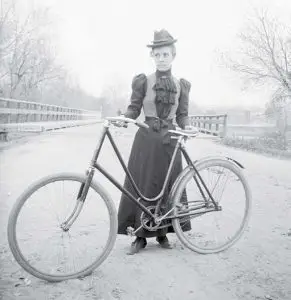
THE MAURO SPECIAL WOMEN’S SAFETY BICYCLE (1898-1902)
Women’s bicycle sold in Denver; Colorado suffragists rode bikes like this door-to-door while campaigning for the vote, which Colorado women won in 1893.
DESPONDENCY VASE (1901)
Art Nouveau ceramic vase by Artus Van Briggle, who came to Colorado seeking a tuberculosis cure; the piece won a Paris Salon gold medal in 1903, the year before Van Briggle died.
FESTIVAL OF MOUNTAIN AND PLAIN “ROUGH RIDERS” RODEO TROPHY BELT (1901)
Sterling silver championship belt from Denver’s premier annual festival, launched in 1895 to revive the city after the Silver Crash of 1893.
NOMA OUTDOOR CHRISTMAS LIGHTS (1936–1938)
Strand of lights tracing to Denver electrician David Sturgeon’s 1914 act of stringing lights outside for his ill son; the tradition grew until Denver named itself the “Christmas Capital of the World.”
COORS MALTED MILK CAN (1923)
Product of the Coors brewery’s pivot during Colorado’s early Prohibition (1916–1933); the company survived by making malted milk and porcelain before returning to brewing.
BEET TOPPER (1910)
Hand tool used by immigrant farm laborers to harvest sugar beets, once Colorado’s most important agricultural crop.
PEACH CRATE LABELS (1923-1975)
Five labels from Western Slope peach growers; Palisade peaches earned national fame and were honored by President Taft at the 1909 Grand Junction Peach Day Festival.
DENVER CITY MARKET BELL (1900-1939)
Bell rung each morning by market master Felice Pomponio to open the Denver City Market on Cherry Creek; his son Michael continued the tradition for forty years.
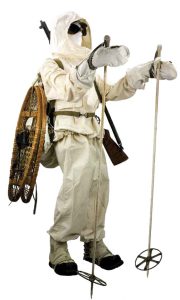
10TH MOUNTAIN DIVISION UNIFORM (1944-45)
White winter warfare uniform worn by soldiers who trained at Camp Hale near Leadville; their assault on Riva Ridge helped liberate Italy, and veterans went on to found Colorado’s ski industry.
Taken together, these objects tell a story no single narrative could contain—of migration and dispossession, ingenuity and injustice, reinvention and resilience. That’s Colorado at 150: a place still becoming what it set out to be.
HISTORY COLORADO CENTER
1200 Broadway
Denver
303.447.8679
historycolorado.org