
A half-century of visibility, resistance, and community
By Lexi Marshall
IMAGINE BEING A TEENAGER—uncertain, sometimes afraid, searching for community. Now imagine that the adults who might understand you best are scattered across the country, and that the act of gathering together in public carries real risk.
That tension between isolation and belonging is not just the story of LGBTQ+ life in decades past. It is, for many, the story of right now.
David Duffield, an LGBTQ+ historian who has spent more than a decade documenting Colorado’s queer history, names it simply: “Storytelling is resistance, and storytelling builds empathy.”
The arc of Denver Pride—from a modest picnic in 1974 to one of the largest Pride events in the U.S.—is a story about what people do when they feel alone. They rebuild community in order to feel safe.
A PICNIC, A MARCH, AND A CULTURAL TRADITION
Denver’s Pride story begins months after what historians call Denver’s own Stonewall moment—the 1973 City Council uprising, when LGBTQ+ activists packed a public meeting to challenge discriminatory laws and police harassment, helping force their repeal.
In the spring of 1974, that surge of visibility carried into the streets, as a small group gathered in Cheesman Park—something between a picnic and a protest, with perhaps 50 to 100 people. By 1976, it had become a march through Denver down Colfax Avenue.
“These early victories set the community up to resist these later attempts to constrict their rights,” says Alejandro Hernández, special collections librarian at Denver Public Library.
Christi Layne, a prominent drag performer and community figure whose full name is Christopher Sloan, secured the permit and led participants along the route. The march traveled from Cheesman Park to Civic Center Park, situated between the state capitol and city hall.
Organizers had faced difficulty obtaining the permit at all, with Sloan later recounting that city officials appeared to delay approval once they understood the parade’s purpose. Marchers carried signs that read “Stop gay bashing” and “Fight back.”
“She was scared,” Duffield says of Layne. “But she was so concentrated on what she was doing that there was little time for anything else—just being in the moment.”
That march established a cultural tradition that has endured for nearly five decades. It sustain Colorado’s LGBTQ+ community long after the parade ended.
The Gay Coalition of Denver, which grew out of the same organizing energy, helped establish what is now The Center on Colfax, the largest LGBTQ+ community center in the Rocky Mountain region.
Hernández also points to KGAY Radio, which launched in November 1992 from a secret Denver location—deliberately kept undisclosed given the hostile climate following Colorado’s passage of Amendment 2—and broadcast nationally via satellite, fielding calls from isolated listeners in small towns across the country.
However, a lack of large-scale commercial support resulted in the station closing shop less than a year after it started. “People will always seek connection,” he says, “and solidarity produces a strength larger than any single individual.”
THE CENTER ON COLFAX: WHERE PRIDE’S MONEY GOES
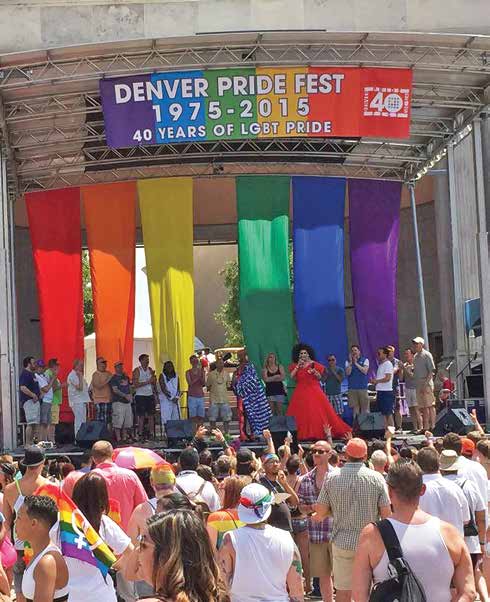
Today, Denver Pride draws approximately 500,000 people, placing it among the top five Pride events in the country. What’s unusual—and largely unknown outside the community—is that Pride is produced entirely by The Center on Colfax.
“Denver Pride is The Center on Colfax. The Center on Colfax is Denver Pride,” says CEO Kim Salvaggio. Every dollar spent at Pride flows back into free services available year-round, including mental health visits, art classes, support groups, and historical programming.
According to The Center, in 2025 it recorded 25,000 check-ins—a 10-percent increase from the year before.
That increase, Salvaggio says, is in part driven by migration. According to the American Civil Liberties Union tracking, more than 500 pieces of anti-LGBTQ+ legislation are currently active across most of the U.S.
Salvaggio describes the personal stakes plainly: She and her wife had to reconsider a driving route through Idaho after new laws raised concerns about safety and legal risk for transgender people using public facilities.
“They cannot drive through Idaho and safely stop and use a public bathroom,” Salvaggio explains. Colorado, relatively more hospitable than its neighbors and more affordable than coastal cities, has become a destination, and The Center is often the first result when someone new to the state searches for help.
Salvaggio expects demand for The Center’s services to grow by another 10 percent this year. Pride proceeds are what keep those services free.
PRIDE 2026: 100 HOURS OF CELEBRATION
This year’s Denver Pride will look different. Civic Center Park, the festival’s traditional home, is under construction. Rather than scale back, organizers have expanded the footprint across the entire month of June, growing from roughly 22 hours of programming to nearly 100.
Events range from the Mutt Strut (a drag show for dogs and humans alike) and Bubbles and Boas (a Cheesman Park brunch following the Pride 5K) to the For the Culture Cookout (celebrating Denver’s BIPOC LGBTQ+ community), a gala at the Brown Palace, a music festival, and a book fair hosted by the Spicy Librarian.
The June 28 parade will follow 17th Avenue, with the festival on 16th Street from Broadway to Arapahoe.
“We want people to see themselves in Pride,” Salvaggio says, “and to choose the events that feel like celebration or protest, or both, for them.”
A HUMAN FESTIVAL
Duffield, who also teaches at Colorado Academy, recently sat with students from Douglas County, Adams County, and southwest Denver—young people who had planned to attend a national conference on student LGBTQ+ groups, only to find it closed due to the political climate.
What struck him was how much they had in common across geography, background, and circumstance.
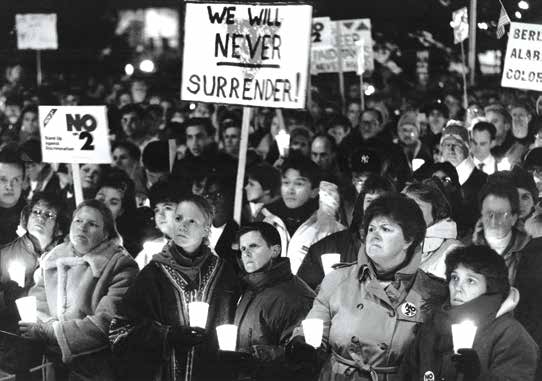
“The commonality is that sometimes we can feel so isolated and so alone,” he says. “It takes a great festival and a great movement of humanity to say, ‘Come join us. Stand in solidarity with us—our common humanity is at stake when we do not.’”
Pride began as a protest because people needed to be seen. That need hasn’t gone away. But as Salvaggio notes, the celebration itself has always been part of the point—sometimes, simply showing up in your own authenticity, in public, is the protest.
Christi Layne understood that in 1976. Nearly 500,000 people understand it still.
THE CENTER ON COLFAX
1301 E. Colfax Ave.
Denver
303.733.7743
lgbtqcolorado.org