
Baxter Fain is on a mission to put the “personal” back into banking in an era of apps and faceless online lenders
By Lexi Marshall
THERE’S A FRAMED newspaper clipping hanging in Baxter Fain’s office that tells you everything you need to know about his relationship with Central Bank. The advertisement, published in the Jefferson City paper in 1985, features a 12-year-old Fain sporting what he now calls “a killer mullet,” promoting the bank’s kids’ checking account program. “I’ve had an account with this bank since I was 12,” Fain says. “I bought my wife’s engagement ring with a line of credit from Central Bank. My first car loan was with Central Bank. My first home loan was with Central Bank.”
Nearly 40 years after that newspaper ad, Fain now serves as President and CEO of Central Bank’s Colorado and North Carolina markets. He says it’s the kind of full-circle moment that still feels surreal to him.
AN UNLIKELY PATH HOME
Fain’s journey to this moment wasn’t a straight line. After leaving Jefferson City, Missouri, for Southern Methodist University, he spent years working for Goldman Sachs in Dallas and New York. His world was commercial real estate and mortgage banking, working for major firms such as JLL, Cushman & Wakefield, and CBRE. He met his wife on a blind date 26 years ago, and because she grew up in Littleton, they moved to Colorado in May 2005.
For three years, Fain worked with Sunflower Bank, his first real experience with a retail-type bank. After that, he figured his banking days were behind him. Then came the chance encounter. Walking through the Denver Tech Center on his way to the now-shuttered Cool River Café for lunch years ago, Fain looked up and saw a familiar logo: Central Bank’s dogwood flower. “I thought, ’Oh my god, that’s Central Bank,’” he recalls. “It’s based in my hometown—they’ve never even been in Colorado. I couldn’t believe it.”
Curious, he stepped inside. Scott Hovey, who had just been hired to do commercial loans, came out to greet him. Fain began referring loans to Central Bank, and his family soon started doing loans on their own properties as well. When COVID hit and larger banks quickly exhausted their PPP funds, he directed those borrowers to Central Bank too, confident—based on a lifetime of experience—that they would be well taken care of. There was never any formal arrangement, he notes; just trust.
When they asked him to do some consulting back in Missouri, he jumped at the chance. He reconnected with high school buddies working at the bank and family friends serving on the board. Then came the offer he thought was a joke: Would he become their CEO for Colorado and North Carolina?
That’s when his mother’s timing proved prophetic. She had moved to Colorado right after COVID-19, bringing a box of mementos for Fain and his sister. Inside was that 1985 newspaper ad. He accepted the position in February 2024.
BANKING LIKE IT USED TO BE
Ask most people who their banker is, and you’ll likely get a blank stare. Banking has become an app on your phone, a screen you check, a branch you avoid unless absolutely necessary. Fain wants to change that. “As everyone’s gotten so busy, it feels like banks have lost their way when it comes to truly being someone’s banker,” he says. “What we’re doing is bringing back high service, high touch, and a proactive approach.” The bank holds events throughout the year, inviting clients and introducing them to each other in ways that actively help grow their businesses. It’s about connection, not just transactions.
The approach is working. In the 22 months since Fain took the helm, Central Bank has more than tripled its deposit base and almost doubled its asset base in Colorado. “We’re not doing it in a risky or careless way. We’re doing it very carefully and specifically—and we’re just getting started,” he says. His vision is ambitious: adding locations every year, moving hundreds of accounts monthly, growing into a multi-billion-dollar bank in Colorado.
“People say this a lot: ‘We didn’t think banking like this existed anymore. I can talk to people again, and I feel like you care about me.’ And that’s the mission,” Fain says.

COMMUNITY AS CORE BUSINESS
But the personal approach extends far beyond customer service. For Fain, community involvement isn’t a box to check or good PR. It’s central to the mission. Last year, across Central Bank’s more than 150 locations, employees logged more than 20,000 community service hours. This year, Fain is aiming for more.
The bank focuses on local groups rather than national organizations, particularly those dealing with what Fain calls “messy things.” They support women’s abuse shelters, organizations that mentor children with incarcerated parents and groups addressing addiction and neglect. One organization holds special significance: FullCircle, which provides sobriety programs for teens struggling with depression, anxiety, self-harm, and addiction. “It’s very common in Colorado,” Fain says. “People don’t talk about it, but depression, anxiety, self-harm, addiction—especially among women—it’s brutal.”
He knows this firsthand. Two of his three children have gone through FullCircle’s program. “My family’s messy too,” he says without hesitation. Central Bank’s first Community Reinvestment Act loan under Fain’s leadership went to FullCircle, helping them finance a new building in Denver. The building opened for meetings this fall. The bank also served as the title sponsor for the Wheels of Dreams charity event, which raised more than $151,000 for FullCircle.
Fain has worked to get these smaller local organizations CRA-qualified through the bank’s compliance department, enabling Central Bank to provide both financial support and volunteer hours while meeting regulatory requirements.
LEADING THROUGH EXPERIENCE
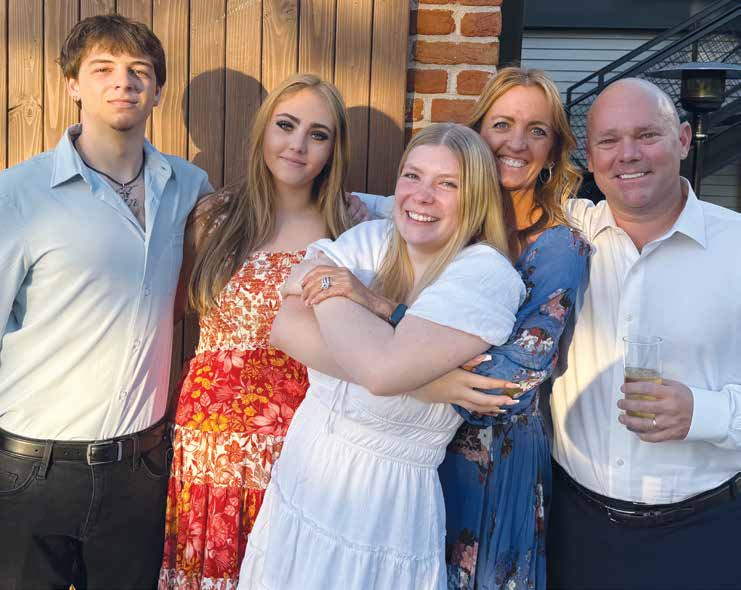
Fain says his faith, his wife, and his children are the true center of his life. After facing infertility, he and his wife adopted two of their three children—an experience he describes as a profound gift. Their youngest was born with the help of a Denver fertility clinic and an egg donor. The path wasn’t always predictable, he reflects, but trust carried them through each turn and made their family what it is today.
The challenges Fain’s family has faced deeply inform how he leads. “We’ve been through a tremendous amount as a family, and through prayer, tenacity, and patience, we’ve made it through,” he says. “What I’ve learned in leadership is that those same things—patience, tenacity and a little prayer—go a long way in guiding your team, too.”
He says those experiences have made him more empathetic and motivated to improve his team’s lives, not just professionally, but personally. “As people, we’re all broken, we’re all messy,” Fain says. “And whenever you raise your hand to let people know they’re not alone, it resonates.”
Fain’s approach hasn’t gone unnoticed by his colleagues. “Baxter impacts his team by asking his employees what they want to do and designing their roles around that,” says Charlie Cartwright, VP and head of private banking for Colorado at Central Bank. “This has resulted in a phenomenal culture at Central Bank. He’s also a huge proponent of helping the community and encourages his employees to volunteer and give back. He leads by example in everything he does for the community.”
A LEGACY CONTINUES
Fain is quick to note that his approach isn’t revolutionary for Central Bank. The bank has operated this way since the Cook family took over in 1905. Bryan Cook, who now owns the majority of the bank, continues that tradition. “That’s how this bank has been my whole life,” Fain says. “What’s fun for me is getting to work with people from back home—they already know what Central Bank feels like. Out here, people don’t know yet, but they’re starting to.”
For someone who never planned to return to banking, who built a career in commercial real estate, who happened to look up at just the right moment and see a dogwood flower logo, Fain has found himself exactly where he’s supposed to be. “I feel extraordinarily blessed and fortunate,” he says. “Every day, I just ask myself, ’What am I going to do today?’”
In a world that often feels fragmented and impersonal, Fain sees his work as quietly powerful. “One person at a time, we are helping our community in a tremendous way,” he says. “And I know it’s just going to continue to grow.”