
The Rocky Mountain Vintage Rally challenged teams at every turn
By Kim D. McHugh
Photo Credits: Andy Mantson
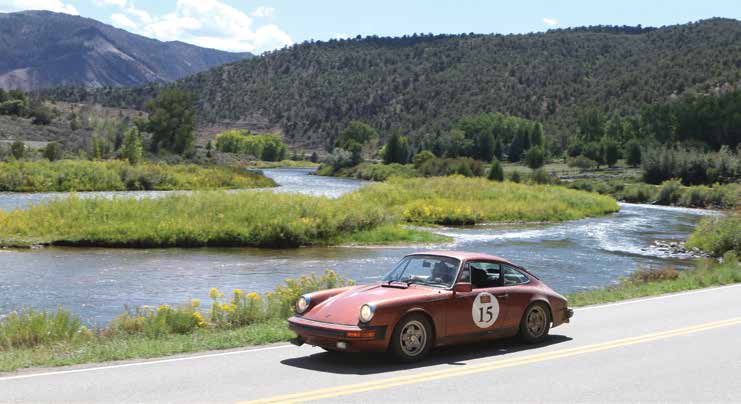
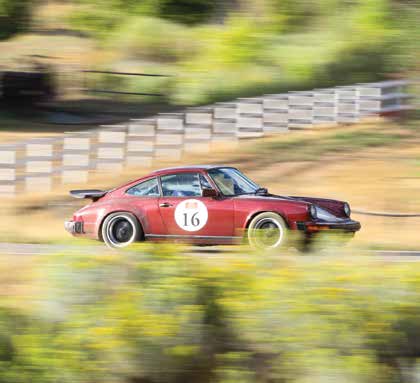
Engines roared to life under Colorado’s boundless blue sky, vintage car silhouettes glinting in the morning sun as drivers prepared to tackle mountain passes, backroads and more than 1,000 miles of pure adventure. This wasn’t your average mountain cruise—it was the inaugural Rocky Mountain Vintage Rally, where classic machinery met modern grit and the open road became both rival and reward. From roaring through red-rock canyons to winding up alpine switchbacks, this endurance rally transformed Colorado’s scenic byways into a living museum of motoring history—equal parts competition, camaraderie and jaw-dropping beauty.
Endurance races and off-road rallies have deep historical roots, dating back to 1907 when the Peking to Paris race debuted, challenging drivers across more than 9,300 miles. Since 1923, France has hosted the iconic 24 Hours of Le Mans, and the famed Dakar Rally—launched in 1979—remains one of the most punishing endurance events in the world. Inspired by these storied competitions, the Pioneer Rally Company brought its own high-adrenaline vision to Colorado last September.
The four-day Colorado event challenged entrants to travel from Colorado Springs to Pagosa Springs, Palisade, Winter Park and back. Testing the skills, strategic thinking and determination of drivers and navigators, the route highlighted the southern Rockies, the San Luis Valley, the Western Slope, wine country and charming small towns. “It seemed logical to organize the first rally in probably the most spectacular scenery North America has to offer,” says Jamie Turner, who co-founded Pioneer Rally Company with Taylor Still. He explains that the accessibility of the mountains and the vast road network made Colorado the ideal location for the company’s inaugural event. Planning began with old-fashioned maps, Google Earth and scouting trips to ensure the roads were both high quality and visually rewarding. They also secured access to private lands to give drivers a more exclusive adventure.
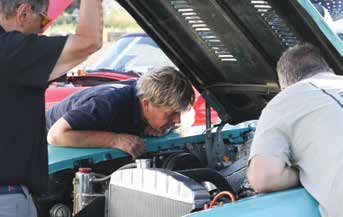
Before setting off, every vehicle underwent a pre-rally technical inspection. Each two-person team then competed in daily stages featuring timed test sections focused on speed, as well as time-speed-distance challenges requiring precise navigation. Eligible vehicles were grouped into categories, including vintage (pre–World War II through December 31, 1945), classic, special vehicles and a Pioneer class for non-competitive entrants or those without an older car.
Among the 18 vehicles entered was a 1970 Volvo 122 nicknamed “Olga,” driven by first-time rally participants Thomas Searls and Carl Helmetag. The out-of-state duo won its class and finished fifth overall—an impressive feat considering only nine of the starting cars completed the rally. “It really was the most exciting, fun experience in racing I’ve ever done,” Searls says. “It challenged me on every level. The adrenaline was just surging. I would do it again in a heartbeat.” He adds that the rally opened his eyes to parts of Colorado he’d never seen, the state’s beauty overwhelming even at racing speed.
Another team featured seasoned rally drivers Matt Bryson of Sydney, Australia, and Danny Day of Yakima Valley, Washington. Veterans of events such as the Peking to Paris and Rally of the Incas in Peru, Bryson served as navigator while Day piloted a 1975 Pontiac Trans Am. “It was a very well-run event, which we won, and we’re quite proud of that,” Bryson says. “The rally organization absolutely nailed the route. It was just stunning. If you’ve got a sense of adventure, an interest in driving a vintage car and being with like-minded people, you should do it.”
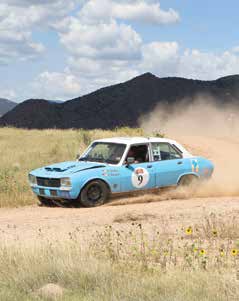
Also competing were experienced rally drivers Shiv Sikland and Dean Drako in a 1969 Peugeot 504. The duo are partners in Drako Motors in Silicon Valley, known for pioneering quad-motor electric hypercars. Sikland notes that their experience racing in South America helped prepare them for Colorado’s high altitudes. “We re-jetted the carburetors to perform optimally in thinner air, especially around Winter Park, where it’s roughly nine thousand feet,” he says. Supporting the establishment of a rally movement in America was a key inspiration for their participation.
Though the driving was the rally’s primary challenge, the teams found equal delight in their nightly accommodations. Stops included The Cheyenne Mountain Resort in Colorado Springs, The Springs Resort & Spa in Pagosa Springs, Wine Country Inn in Palisade and The Vintage Hotel in Winter Park. Hearty breakfasts, delicious dinners and newfound camaraderie made the adventure unforgettable.
By the time the last team rolled—or pushed—across the finish line, every mile had become a story of grit, grace and the intoxicating freedom of chasing the horizon. For the pioneers of the Rocky Mountain Vintage Rally, this event was more than a drive—it was a declaration that adventure is alive and well, waiting just beyond the next mountain pass.
Upcoming Vintage Rallies
ROCKY MOUNTAIN VINTAGE 2026
• Date: August 12–22 (estimated)
• Duration: 11 nights, 10 days
• Route: Santa Fe, New Mexico → Coeur d’Alene, Idaho
• pioneerrallycompany.com
SUNBELT VINTAGE RALLY 2026*
• Date: April 30–May 11 (estimated)
• Duration: 11 nights, 10 days
• Route: Arizona, California, Utah, Colorado & New Mexico
• pioneerrallycompany.com
Reservations accepted through December 31, 2025
THE COLORADO GRAND
• Date: September (estimated)
• Duration: 5 days
• Route: Starts and ends in Vail
• co1000.com
THE REBELLE RALLY 2026
• Date: October 7–17
• Duration: 11 days, 8 days of competition
• Route: 1,550 miles across Nevada/California deserts
• rebellerally.com